SIMUGAL · BUYING GUIDE · UPDATED 26 OCT 2026
Load-cell pedals: how to choose well in 2026
Choose a brake you can control lap after lap. We explain what a load cell measures, how pedal feel changes and how to compare eleven pedal sets for your needs.
The priority: a stable mounting, a comfortable driving position and a braking force you can repeat throughout the race.
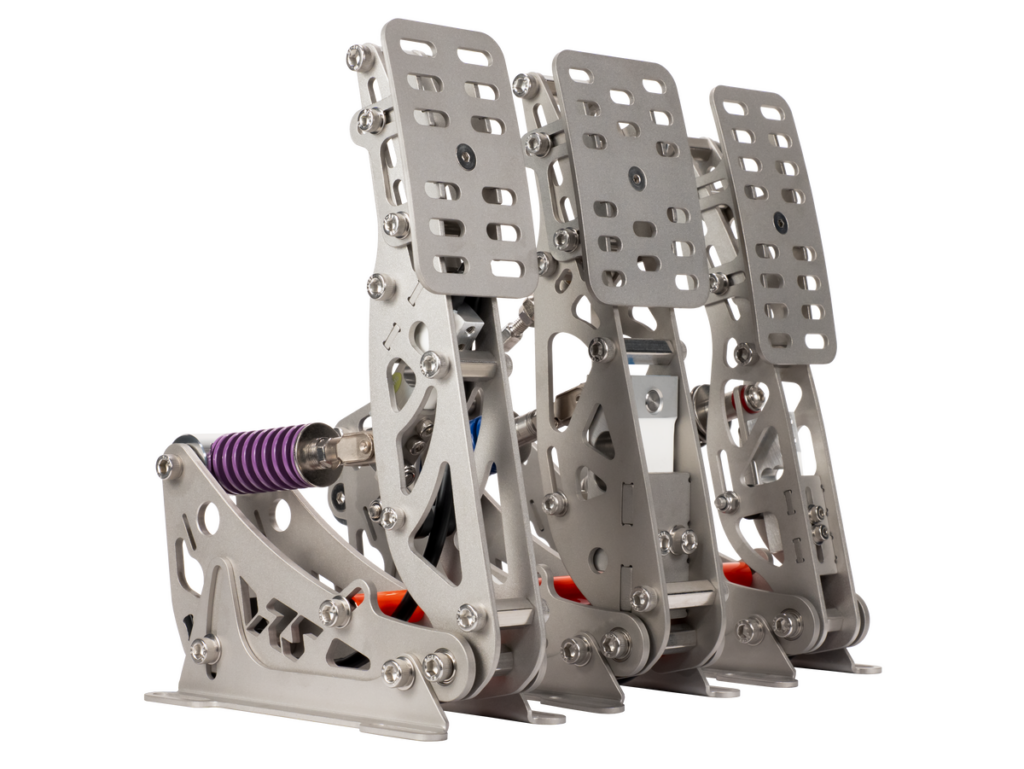
VRS DirectForce Pro. Product image from Simufy; the set shown includes a clutch.
01 · Sensor
Force and travel are different measurements.
02 · Mounting
The pedals and seat must stay firmly in place.
03 · Setup
Calibrate using a comfortable, repeatable force.
Which pedals to choose for your budget and mounting
Start with a set you can install securely. These are ways to use the comparator, rather than a ranking based on testing every pedal set.
- Up to €300 for the pedals: compare the throttle-and-brake versions of the MOZA SRP2 and Simagic P700. If you need a clutch from the start, compare the cost of adding one with the Fanatec CSL Elite V2 set, which includes three pedals. Leave room for mounting hardware and shipping.
- Between €300 and €500: compare the CRP2, P1000, Forte and XP1 with the same number of pedals. Decide on geometry, documented feel, adjustments and accessories; the price of a separate clutch is not the price of a complete pedal set.
- From €500: broaden the comparison to include Sprint, VRS, P2000 and Ultimate+. Check the platform, electronics and extras for each variant before finalising your budget.
- A desk or a chair that moves: prioritise stabilising the mounting. A firmer brake does not compensate for a seat that moves.
The price bands are a guide to the configurations shown: check each variant’s price in the comparator and the shop. If you use a console, check the official pedal-and-wheelbase combination; a separate USB connection does not mean compatibility with PlayStation or Xbox.
Compare SRP2 and P700 (in Spanish) · Calculate the cost of your complete rig. The eleven-model comparator continues below so you can review configurations and differences.
UNDERSTANDING THE BRAKE
What a load cell is and what it offers
A load cell converts the force applied to it into an electrical signal. In a sim-racing brake, that signal is used to calculate the braking input. A position sensor — such as a potentiometer or a Hall sensor used to measure angle — derives its signal from pedal movement.
The practical difference is your reference point: the effort applied or the position reached. With a stable mounting and suitable calibration, braking by force can help you reproduce the same input. Adapting takes practice: changing pedals does not guarantee faster lap times.
Sensor and feel: two separate decisions
The load-cell label does not define how far a pedal moves or how its resistance increases. That depends on its geometry and components such as springs, elastomers or hydraulic mechanisms. Some load-cell brakes have plenty of travel, while others have a much firmer feel.
For the same reason, hydraulic and load-cell are not mutually exclusive categories. One describes part of the mechanism; the other describes a type of sensor. Check how each model measures input and generates resistance, rather than buying on the label alone.
Why 100, 120 or 140 kg cannot be compared directly
One specification may state the cell’s rated capacity, while another gives the maximum force at the pedal face. Leverage and foot position mean those figures are not equivalent. Sprint is a documented example: Heusinkveld distinguishes a 120 kg cell from a maximum actual pedal force of 65 kg.
The maximum figure describes a limit of the assembly, rather than a training target. Choose a force you can repeat without lifting your pelvis, pulling on the steering wheel or moving the chair.
YOUR RIG COMES FIRST
What to check before buying
Start with the platform. Every model compared supports PC; console compatibility depends on the model and the official wheelbase-and-wheel combination. A separate USB connection does not establish compatibility with PlayStation or Xbox. Fanatec CSL Elite V2 and MOZA CRP2 support specific console combinations, noted in the comparator. If you use a console, check the exact pedal, wheelbase and game combination in the manufacturer’s documentation.
Next, check the structure. Measure the pedal tray and check the hole pattern, fasteners and room for cables. Adjust the seat distance and angle as well. A baseplate or heel rest can help with installation, but does not replace a rigid connection between the seat and pedals.
Price the installed setup. Compare throttle and brake with throttle and brake: a two-pedal price is not equivalent to three pedals with a baseplate. Add a clutch if needed, mounts, adapters and accessories. A pair may be enough for GT cars with paddle shifting; for manual cars with an H-pattern shifter, consider a clutch according to the simulator and assists you use.
If you play at a desk and the chair moves under braking, address that instability first. Heusinkveld requires a complete cockpit for Sprint, even with its optional baseplate.
Compare up to three pedal sets
Filter the models and choose those you want to compare. Switch between two and three pedals to see the price of the corresponding configuration.
Simufy prices checked on 26/10/2026, including VAT. Confirm shipping, optional accessories and availability with the shop. Several Simufy listings show the notices available for shipping and pre-order at the same time; we do not interpret this as immediate stock. The P2000 listing gives 13 November 2026; for the others we do not publish an unconfirmed arrival date. Photographs may show other variants of the same model.
Your comparison
On mobile, swipe the table sideways to see every column. The CSL Elite V2 price always includes three pedals.
Browse models with photos and prices
Summary of base configurations. Enable JavaScript to select models and compare their features.
| Model | Base set | Price |
|---|---|---|
| MOZA SRP2 | 2 pedals; no stop or Performance Kit | €159.99 |
| Simagic P700 | 2 pedals; no haptics or stop | €229.99 |
| Fanatec CSL Elite V2 | Includes 3 pedals; no separate pair at this link | €299.95 |
| MOZA CRP2 | 2 pedals; no Performance Kit or inverted mounting | €399.99 |
| Simagic P1000 | 2 pedals; mechanical brake; no haptics | €419.99 |
| Asetek Forte | 2 standard Forte pedals; not S-Series | €489.99 |
| Sim-Lab XP1 | 2 pedals; no additional baseplate | €498.99 |
| Heusinkveld Sprint | 2 pedals; no baseplate | €549.99 |
| VRS DirectForce Pro | 2 pedals; no clutch | €599.99 |
| Simagic P2000 | 2 pedals; Standard plate; confirm the batch's load cell | €619.99 |
| Heusinkveld Ultimate+ | Silver; 2 pedals; no baseplate | €1,179.99 |
How to interpret this comparison
A load cell's rated capacity and the force applied at the pedal face are different quantities. We distinguish them only where the documentation permits. Check the specification for any unspecified value; we do not estimate it.
Haptics, baseplates, hydraulic kits or inverted-mounting kits are optional where indicated. We do not assign scores for precision or reliability, or rank models by kg figures.
Simufy links are affiliate links: SimuGal may receive a commission at no extra cost to you. Read the SIMUGAL terms (in Spanish).
THREE BUYER PROFILES
VRS, Sprint and P1000: three reference points to compare
These three pedal sets are sold by Simufy and serve different priorities. The selection is based on official documentation and the retail configurations checked. Feel and comfort require personal judgement; we do not assign scores for precision, noise or reliability here.
MECHANICAL ADJUSTMENT
VRS DirectForce Pro
The brake combines a load cell, a spring and a lever mechanism that produces a progressive response. VRS advertises up to 140 kg of force at the pedal face and allows the geometry and mechanical response to be adjusted.
A good fit if: you want to spend time tuning the feel and mount the pedals on a rigid structure. Its configuration tool allows calibration and saved profiles.
Before choosing: check the mounting and heel support. We do not assume a baseplate is included in the two-pedal price.
SOFTWARE AND PROFILES
Heusinkveld Sprint
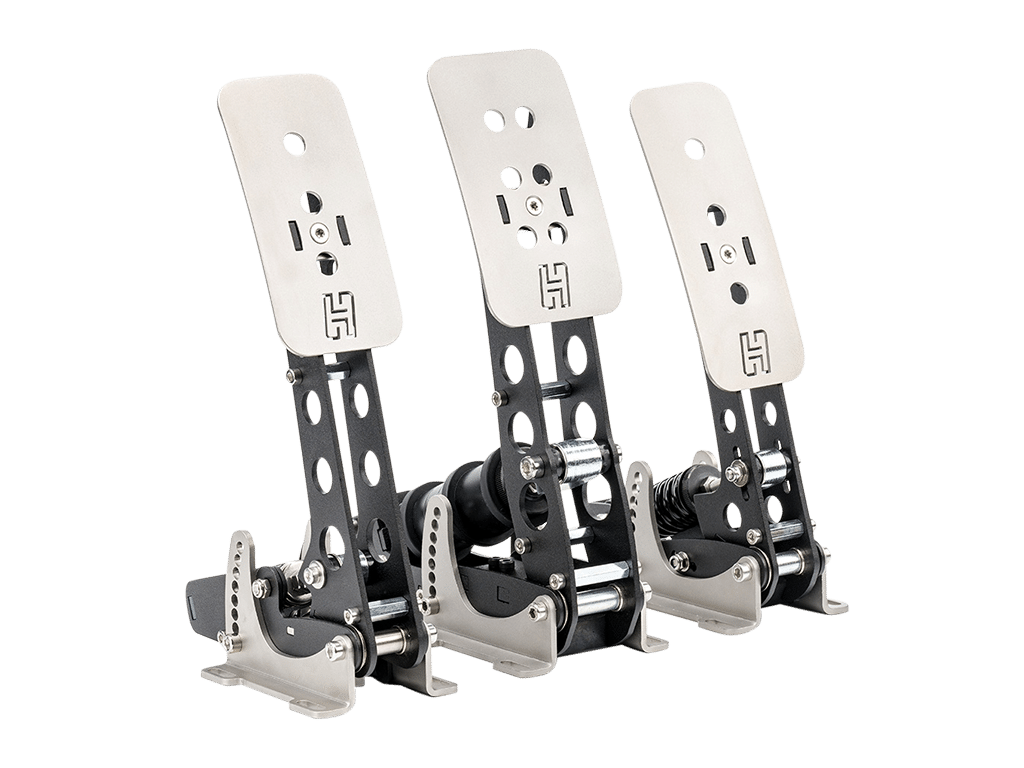
These offer an elastomer brake with up to 65 kg of actual pedal force. SmartControl lets you configure output curves, dead zones and braking force, as well as save profiles.
A good fit if: you want to combine mechanical adjustments with detailed software configuration in a complete cockpit.
Before choosing: distinguish the two- and three-pedal versions and the options with or without a baseplate. The Sprint Baseplate is offered separately and in certain shop configurations.
MODULAR UPGRADES
Simagic P1000
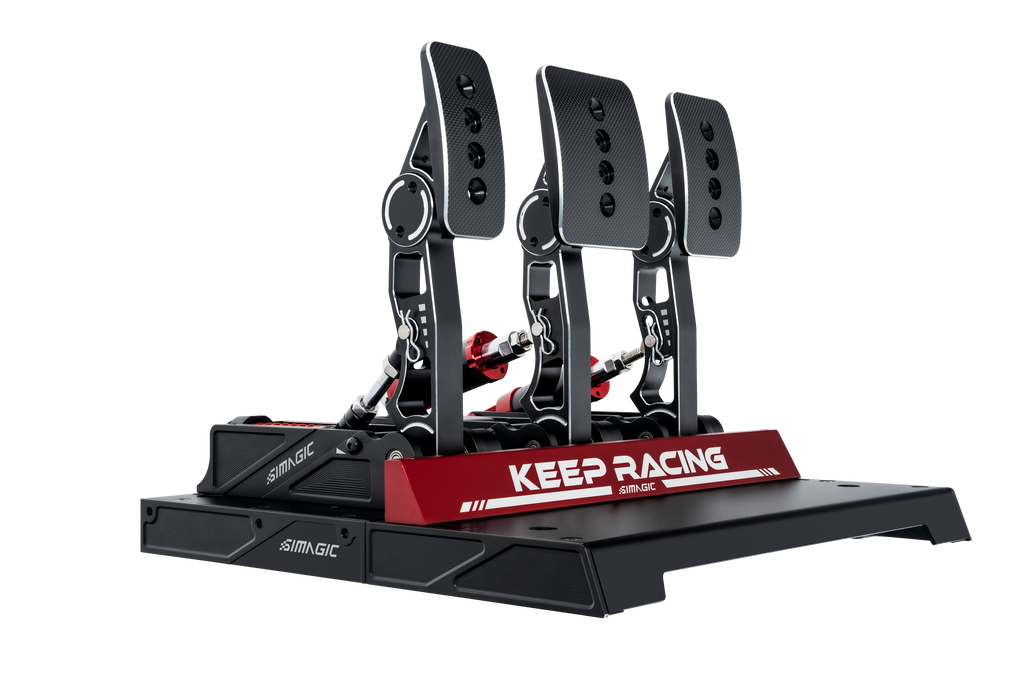
The range includes a brake with a 100 kg rated load cell and a Hall angle sensor. The reading mode can be selected according to the configuration. Mechanical and hydraulic options and haptic accessories are available.
A good fit if: you want to upgrade your pedal set in stages with components from the P1000 ecosystem.
Before choosing: check the variant and the accessories required. Haptic reactors and their power requirements should not be assumed to be included in the base set.
More detail in our P1000 and P1000i guide (in Spanish).
Product photographs: VRS/Simufy, Heusinkveld and SIMAGIC. The images illustrate the sets; check the number of pedals and accessories in the linked variant.
Eight alternatives to broaden your choice
The catalogue also covers entry-level load-cell braking, the Fanatec ecosystem and different mechanical or hydraulic approaches to pedal feel. These eight models join VRS DirectForce Pro, Heusinkveld Sprint and Simagic P1000.
MOZA SRP2
Getting started with load-cell braking
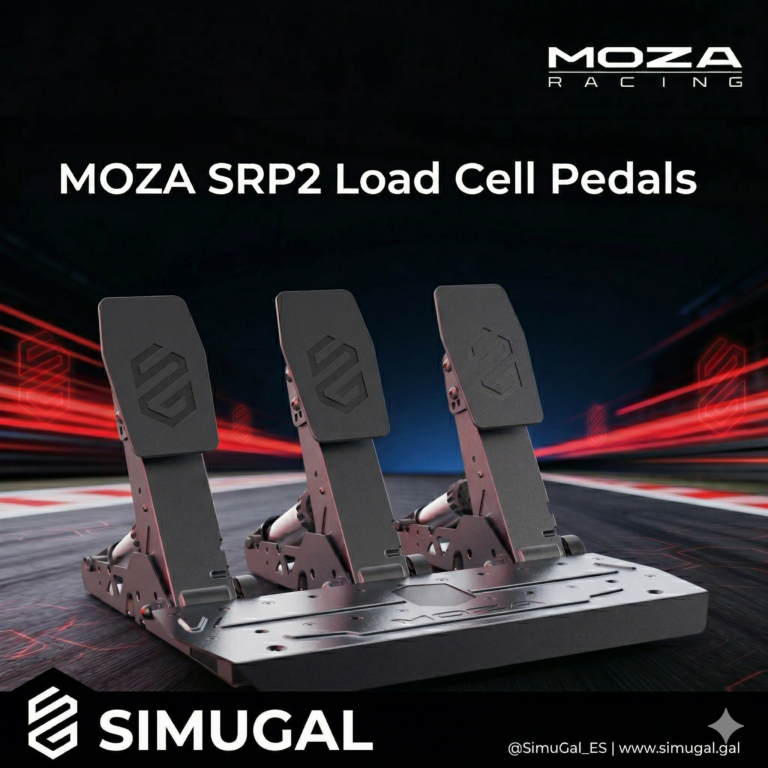
A way to get started with force-based braking, with adjustable resistance and force and angle sensors. Separate the base set’s price from the clutch, stop and optional kits.
€159.99 · 2 pedals; no stop or Performance Kit.
Simagic P700
Affordable adjustment and upgrades
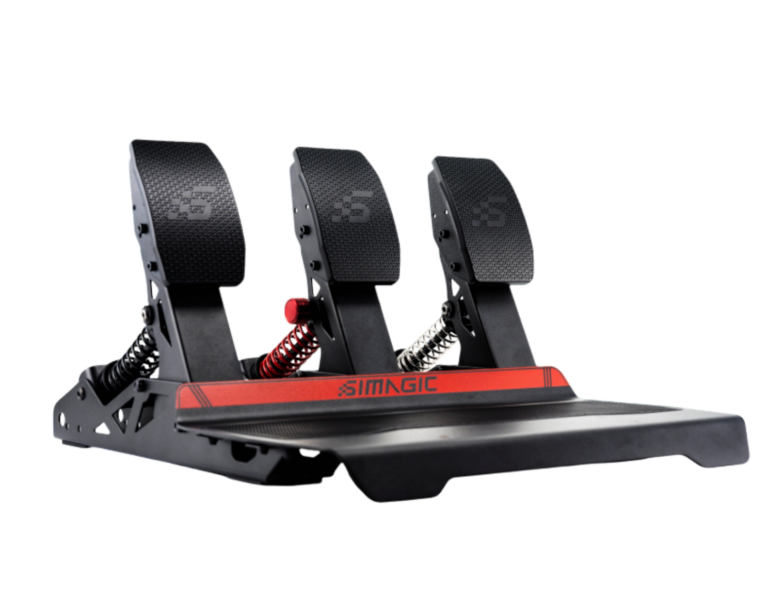
Broadens the entry-level options with two reading modes, brake adjustments and optional haptic reactors. SIMAGIC recommends rigid mounting to make use of the load-cell mode with greater resistance.
€229.99 · 2 pedals; no haptics or stop.
Fanatec CSL Elite V2
Three pedals and the Fanatec ecosystem
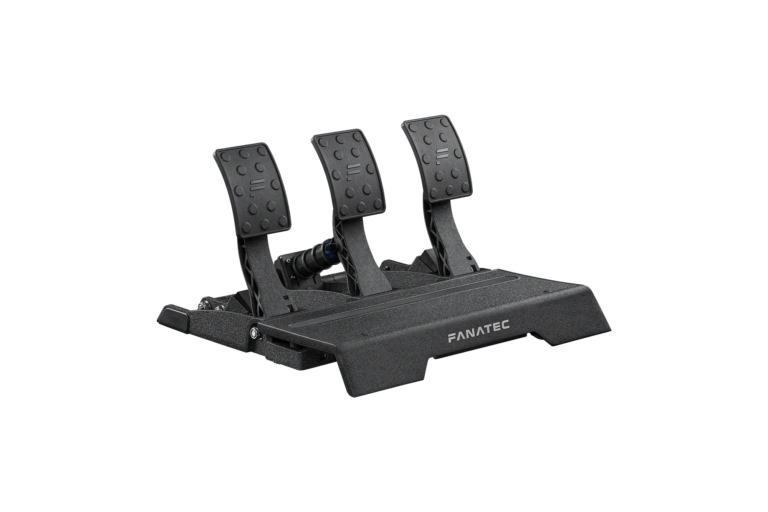
A relevant option if you need a clutch from the start or use a Fanatec wheelbase. The retail package includes three pedals: the comparator retains that fact even in the two-pedal view.
€299.95 · Includes 3 pedals; no separate pair at this link.
MOZA CRP2
More adjustment within MOZA
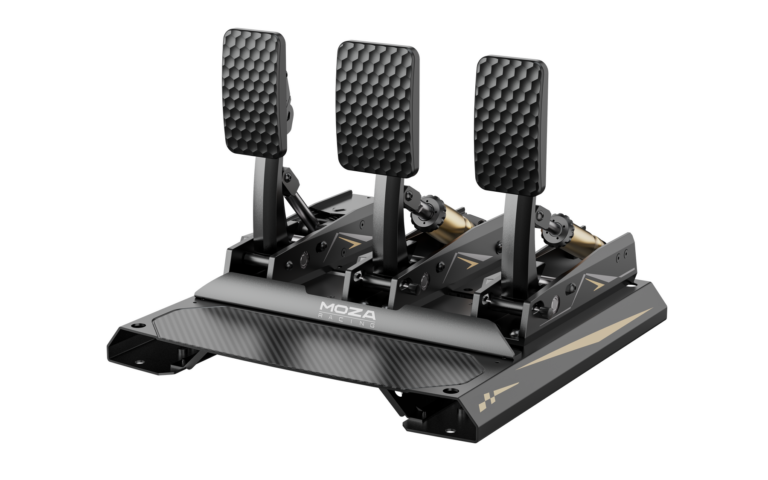
A higher-level MOZA option for comparing the cost of the pair with adjustment or inverted-mounting kits. Its 200 kg rated capacity is not presented as the force the user should apply.
€399.99 · 2 pedals; no Performance Kit or inverted mounting.
Asetek Forte
Short, firm brake feel
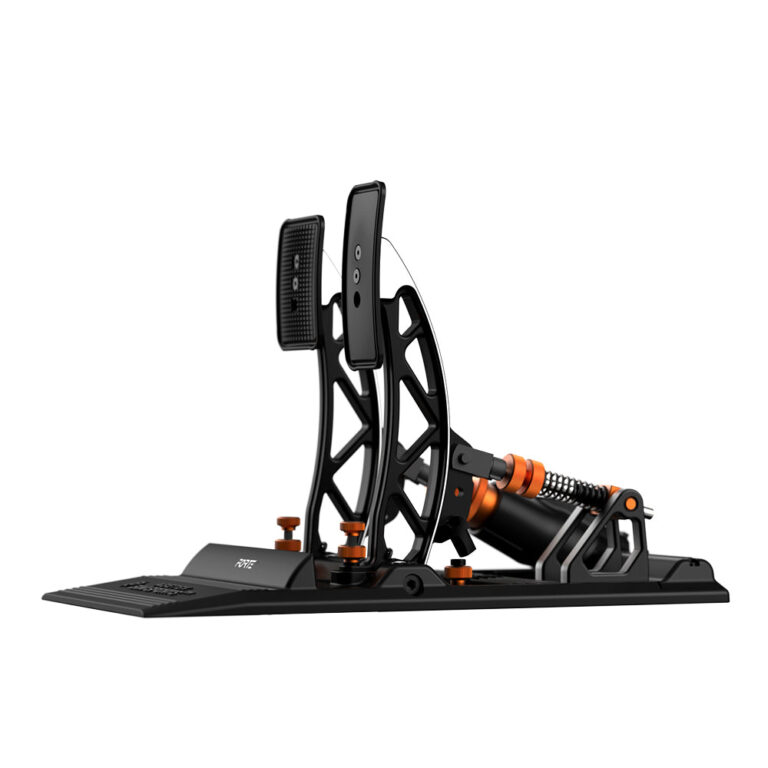
Offer a different approach to feel: a two-stage mechanical MLCPC cylinder designed for a short, firm response. It is not a hydraulic circuit. We compare standard Forte without mixing its price with the S-Series range.
€489.99 · 2 standard Forte pedals; not S-Series.
Sim-Lab XP1
Independent geometry and adjustment
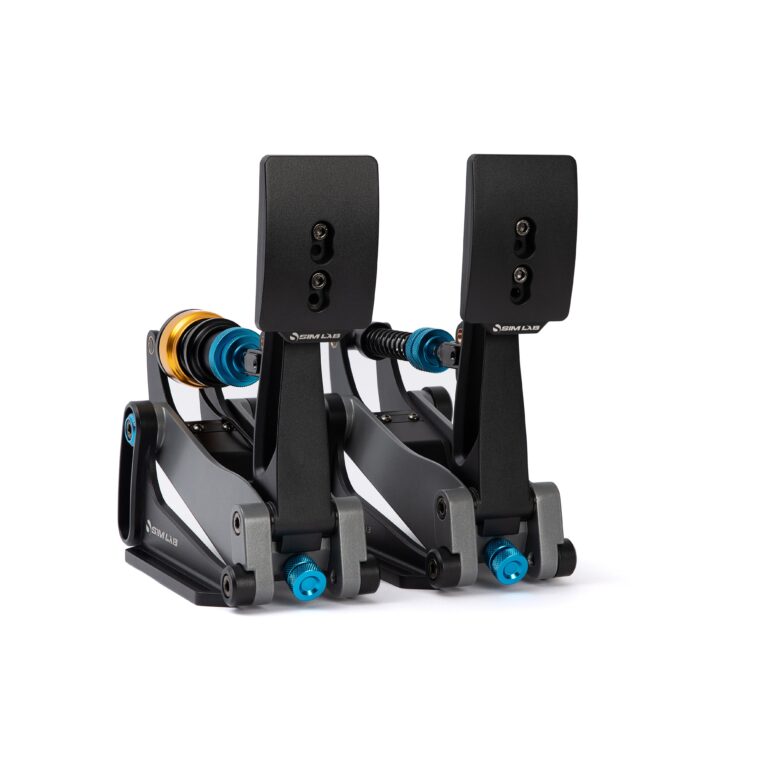
An alternative if you want to adjust each pedal’s position, angle and resistance. RaceDirector allows the signal to be adjusted and profiles saved. The price of a separate clutch is not used as the price of a complete pedal set.
€498.99 · 2 pedals; no additional baseplate.
Simagic P2000
Hydraulics with force measurement
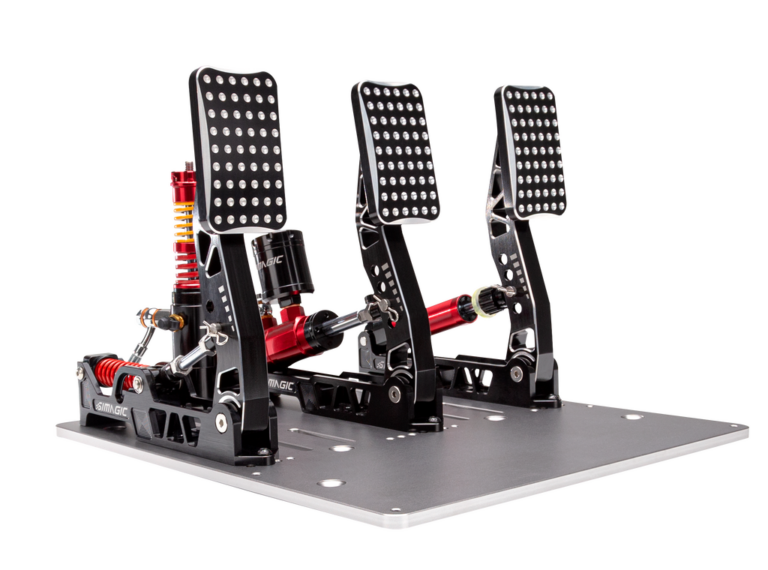
Combine a hydraulic circuit and a load cell. The comparison uses the Standard plate and distinguishes two and three pedals. Confirm the cell in the specific batch: the retail selector checked does not identify its rated capacity.
€619.99 · 2 pedals; Standard plate; confirm the batch’s load cell.
Heusinkveld Ultimate+
High-end adjustment
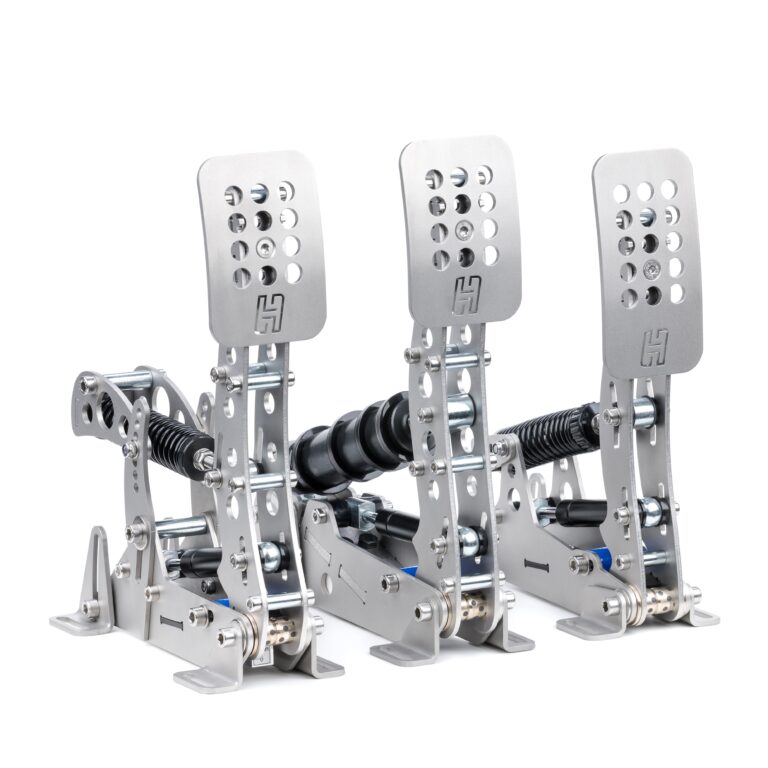
Add adjustable hydraulic damping to the load-cell set. They illustrate the difference between creating feel through dampers and using a hydraulic braking circuit. The compared variant is Silver without a baseplate.
€1,179.99 · Silver; 2 pedals; no baseplate.
The prices shown are for the linked configurations, checked on 26/10/2026, including VAT and excluding shipping. Photos may show three-pedal sets or other finishes; the selected variant’s contents take precedence. The comparator lets you switch to three pedals where that option exists. The Fanatec CSL Elite V2 package always includes three.
FROM INSTALLATION TO THE TRACK
How to calibrate a load-cell brake
- Secure and adjust the setup. Check that the seat and pedals do not move. Adjust your driving position before choosing the maximum effort.
- Open the manufacturer’s software. Follow its wizard or manual. If the model allows sensor selection, check that you are using the mode you want to calibrate.
- Set the rest position. Check that the brake registers no input when released. Apply a small dead zone only if needed to remove unintended inputs.
- Set a repeatable maximum. Use a force you can sustain during the session, within the manufacturer’s limits. You do not need to reach the sensor’s maximum capacity.
- Check the simulator. Review the axes, their direction and the input range. Start with a linear response and avoid stacking curves without understanding what each one changes.
- Validate on track. Keep the car, fuel and conditions comparable. Watch the brake application, release and wheel locking. Change one variable at a time.
If you reach 100% input with very little effort, check the calibrated maximum before changing springs. If you can barely reach the maximum or strain your driving position, reduce the target force. After mechanical changes, check the calibration using your model’s manual.
For trail braking, work on a gradual, controlled release. The pedal helps you give the input; the car’s balance also depends on its setup and grip. Explore this further in our brake-bias guide.
THE DECISION
Where to invest first
If the rig moves under braking: invest first in securing the seat and pedals. Increasing the force does not solve flex in the mounting.
To get started: compare SRP2 and P700 against your mounting and budget. If you need three pedals or use Fanatec, add CSL Elite V2 to the comparison.
With a solid cockpit: compare CRP2, P1000, Forte and XP1 for feel, geometry and extras. Sprint and VRS broaden the comparison of adjustments and software; P2000 and Ultimate+ help you evaluate different hydraulic solutions.
If you already have a load cell that works well: justify a change through a specific limitation in ergonomics, adjustment or features. Work on calibration and technique as well.
COMMON QUESTIONS
Frequently asked questions
Do I need a load cell to compete?
No. You can practise and compete with other sensors. A load cell changes how braking is measured and can be a useful upgrade if it suits your mounting and driving style.
Does a higher kg figure mean a better pedal?
Not on its own. Check whether the figure refers to the sensor or the effort at the pedal, and consider the range you can use comfortably, the geometry and the adjustments.
Does a spring or elastomer turn my pedals into load-cell pedals?
Changing resistance does not replace the sensor. Measuring force requires a compatible system that measures it and the corresponding electronics.
Can I use them with another brand's wheelbase?
On PC, a pedal set with a separate USB connection can work alongside a different wheelbase if the game supports both devices. Check the specific requirements. That combination does not establish console compatibility.
Do haptics turn a pedal set into an active system?
A haptic reactor adds vibrations or cues to the pedal. That alone is not equivalent to a system capable of actively changing resistance or the force curve. Assess each feature for what it provides.
DOCUMENTATION
Sources and approach used in this guide
Technical data cross-checked against VRS DirectForce Pro, Heusinkveld Sprint and SIMAGIC P1000. For mounting and adjustments, also consult the official Sprint manual and the manuals linked on the manufacturers’ pages.
Retail configurations and prices were checked at Simufy on 26/10/2026. Recommendations about suitability are SimuGal’s editorial judgement based on those data. This update is not presented as a comparison test of the three physical units or as our own measurements.
The expanded comparison also consults the official pages for MOZA SRP2 and CRP2, SIMAGIC P700 and P2000, Fanatec CSL Elite V2, Asetek Forte, Sim-Lab XP1 and Heusinkveld Ultimate+, linked beside each model and within the comparator. Prices are taken from specific Simufy variants, rather than the ‘from’ prices that may refer to a separate clutch.
Build a balanced rig
Include the pedals, mounting and accessories in the complete budget for your simulator.
If you are still deciding between changing the pedals and improving their mounting, first identify what is limiting your rig.
Get sim-racing and motorsport news
Leave your email address to receive the next SimuGal updates. You can unsubscribe at any time.
Read the privacy policy.