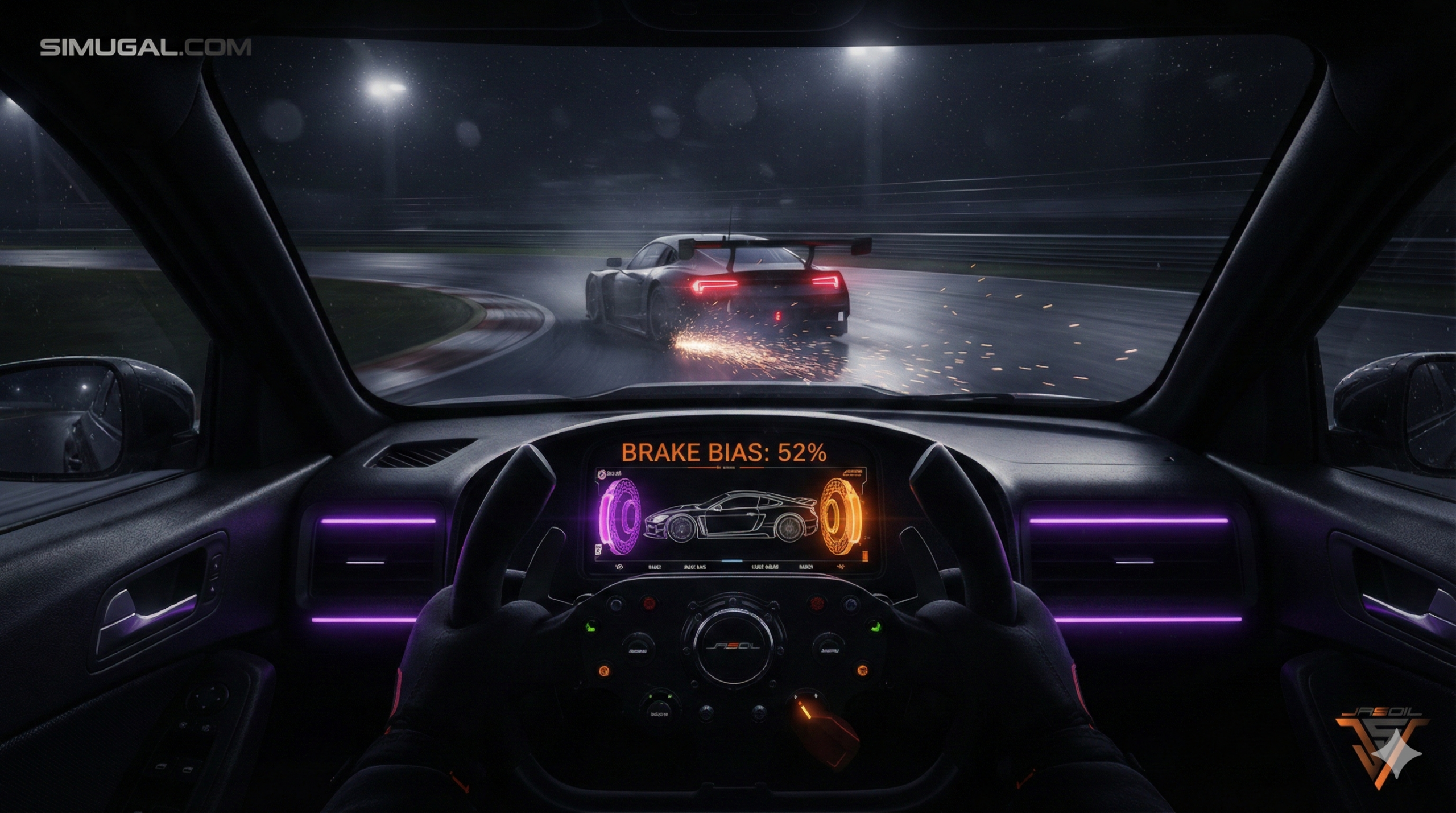
How to adjust brake bias without getting lost
The percentage indicates how much braking force is sent to the front axle. A 53 % front bias leaves the remaining 47 % at the rear. Under braking, load transfer increases the available grip at the front and unloads the rear axle.
More towards the frontMore stability, but it can increase front locking and understeer on entry.
More towards the rearMore rotation and involvement from the rear axle, with a greater risk of instability or locking.
In the wetA small shift forwards usually adds some margin, but it depends on the car, ABS and tyre.
Recommended test method
- Start with the base setup or manufacturer's value.
- Use the same corner and a comparable fuel load.
- Change just 0.5 points at a time.
- Keep the value that lets you brake at the limit repeatably.
Quick questions
Is there a perfect brake bias for every GT3?
No. It varies with the model, fuel load, tyres, ABS, track, driving technique and simulator. The configurator provides a reference to start testing.
What should I do if the car spins under braking?
First move the bias forwards by 0.5 points and check downshifts, brake pressure and whether locking starts at the rear.
Why will the car not turn while trail braking?
An excessively forward bias can overload the front axle. Move it rearwards in small steps if the rear axle remains stable.
Does ABS correct poor brake bias?
It prevents locking, but does not turn an inefficient bias into an optimal one. If it intervenes too early on one axle, the car may brake less effectively and its balance may change.
Should I change it during a race?
It can be useful when fuel, tyres or grip change. Make small changes, and only if you clearly understand the symptom you want to correct.